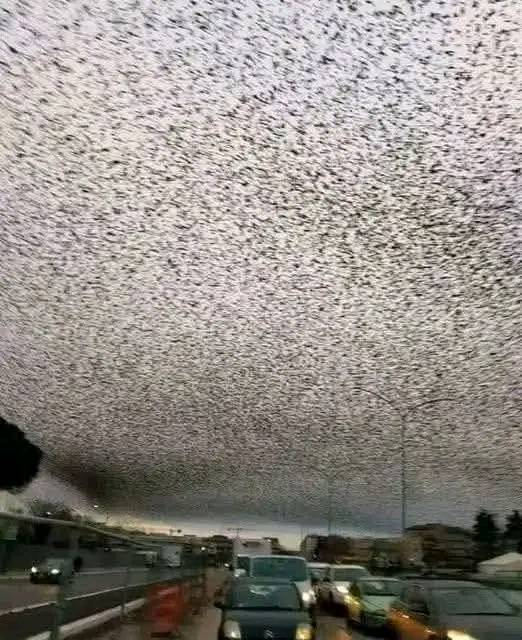
Every winter, thousands of starlings migrate to Rome from northern Europe, forming huge flocks that look like living clouds at sunset.
They move there because of the city’s mild climate.
They fly in perfect synchronicity, creating mesmerizing shapes.
Although it’s a beautiful spectacle, they leave the streets slippery with their droppings.
The authorities try to scare them away, without much success.
An aerial dance that blends beauty, chaos, and the power of nature in the very heart of Rome.
The video captures a spectacular natural phenomenon known as a starling flock, where tens of thousands of birds fly in perfect synchronization over an urban highway. This mesmerizing collective flight, exhibited primarily by
European starlings at dusk, occurs when large flocks gather to roost. The flocks serve crucial survival fu nctions, such as protecting the birds from predators like hawks and sparrowhawks thanks to the safety provided by the group.
The sweeping visual movement created by thousands of synchronized wings resembles a giant billowing cloud against the twilight sky. Scientists study flocks using complex physics and computer models to understand how thousands of individuals communicate and react almo st instantaneously. Each bird in the flock responds dynamically to the movements of its six or seven nearest neighbors, creating r
apid and fluid changes of direction without collisions. Urban highways, bridges, and city perimeters often serve as conce
ntration zones for starlings due to the warmer microclimate s generated by urban heat islands. Drivers traveling on busy roads often witness these spectacular avian displays as the birds congregate before roosting in nearby tree
s, bridges, or reed beds. Large flocks of starlings can cause minor nuisances in urban environments, such as noise, droppings, and o
ccasional visual distractions for motorists. The intricate pattern formation observed in starling flocks is considered one of the most remarkable examples of emergent self-organization in animal behavior. Ornithologists note that the flocks reach their peak during the fall and winter months, when migratory starling populations join resident flocks in urban and suburban areas. The collective movement patterns help the birds exchange information about local food sources, weather conditions, and optimal roosting sites. Predators attempting to hunt an individual bird within a flock face enormous confusion due to the constant and shifting mass of thousands of moving bodies. The acoustic sound generated by tens of thousands of beating wings creates a deep, distinctive hum, from which the term “flock” was originally derived. Modern high-definition
digital cameras allow researchers and wildlife enthusiasts to accurately capture the dynamics of flocks in fractions of a second. Urban streetlights, highway illumination, and vehicular traffic create a striking visual contrast with the dark, sweeping canopy of the flock in flight. Environmental factors, such as sudden gusts of wind or the approach of aerial predators, can cause dramatic changes in the flock’s shape in fractions of a second.
Flocks of starlings highlight the incredible adaptability of wildlife to thrive in increasingly urbanized landscapes alongside dense vehicular infrastructure. Studies in computational fluid dynamics and robotics draw inspiration from the
mechanics of bird flocks to design safer swarms of autonomous drones and traffic management algorithms. The synchronized turning mechanism relies on rapid acoustic and visual signals that propagate through the flock at speeds far
exceeding human reaction times. Urban wildlife conservationists advocate for the protection of urban green spaces and roosting sites to ensure that native and migratory bird species can thrive safely. The dense concentration of birds during
flocking acts as a natural collective heat-exchange strategy as temperatures drop at dusk. Heavy traffic beneath the flock moves slowly,
and drivers observe the impressive natural aerial display during the evening rush hour. European starlings have been introduced to
several continents outside their native range in Europe, where they have adapted exceptionally well to diverse urban ecosystems. The visual appearance of a flock can rapidly change from a wide, scattered sheet in the sky to a dense,
dark funnel as the flock prepares to land. Wildlife photographers often gather near known roosting sites at dusk to capture the fleeting,
geometric beauty of large-scale flock behaviors. The fluid dynamics exhibited by starling flocks illustrate how simple individual rules produce highly complex and coordinated group behavior in nature.