Few foods have traveled quite as far from their original identity as bologna.
Today, the name often brings to mind neatly stacked pink slices, plastic packaging, school lunches, simple sandwiches, and the familiar question of whether someone wants their bologna fried or cold.
But behind that everyday image is a much older culinary story.
Bologna is not simply a processed meat invented for modern supermarkets. Its history can be traced to Italy, where the product known as mortadella became one of the country’s most recognizable cured meat traditions.
The connection between the two is one of the most fascinating parts of the food’s history.
Traditional mortadella originated in Bologna, a city in northern Italy famous for its food culture.
Unlike the uniform slices commonly associated with American bologna, traditional mortadella has a distinctive appearance.
Large pieces of fat are distributed throughout the finely processed meat, and some versions contain pistachios or other seasonings.
The texture is smooth and rich, but the visible pieces of fat immediately distinguish it from the pale, uniform slices found in many American refrigerators.
As the tradition traveled across borders, however, the product changed.
Immigrants brought European food traditions with them, but recipes rarely remain completely unchanged after crossing an ocean.
Ingredients available in a new country can be different.
Manufacturing methods evolve.
Consumer preferences change.
And eventually, a traditional food can become something that only vaguely resembles its original form.
That appears to be part of what happened with bologna.
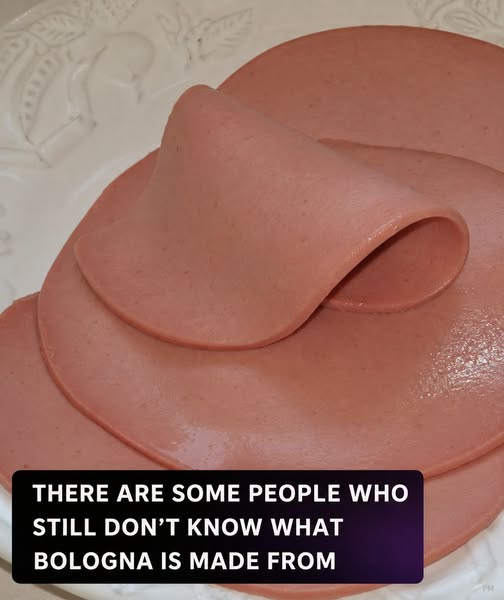
American-style bologna developed into a more standardized product.
Instead of emphasizing the visual contrast between finely processed meat and large pieces of fat, many versions became smoother and more uniform.
That consistency made the product especially practical for large-scale manufacturing.
The meat could be finely ground and combined into an emulsion before being cooked.
Depending on the product, different meats may be used, including beef, pork, chicken, or combinations of them.
Seasonings and other ingredients are incorporated before the mixture is processed and cooked.
The result is the familiar soft texture associated with bologna.
Once sliced, the pieces are almost perfectly uniform.
That uniformity may seem unimportant today, but it was a major advantage for mass production.
Factories could produce enormous quantities of identical slices.
Those slices could then be packaged, transported, refrigerated, and sold across the country.
Bologna became particularly associated with affordability.
For families trying to stretch their grocery budgets, it was a practical source of protein that could be used in simple meals.
A few slices could be placed between two pieces of bread with mustard, mayonnaise, cheese, or whatever ingredients happened to be available.
The sandwich required little preparation.
That simplicity helped bologna become a staple of American lunch culture.
For generations of children, it became associated with school cafeterias and packed lunches.
The food was inexpensive, easy to store, and simple to prepare.
It also became the subject of countless jokes and cultural references.
The name itself became part of everyday language.
People often pronounced it differently from the Italian city of Bologna, and the word developed a distinct identity in American culture.
Despite its humble reputation, bologna represents something much larger than a simple lunch meat.
It demonstrates how food traditions evolve when they move between cultures.
A recipe is never completely frozen in time.
People modify it according to their resources, tastes, technology, and circumstances.
The food that arrives in a new country may gradually become something new.
In the case of bologna, the transformation involved both ingredients and manufacturing.
Traditional mortadella is a carefully crafted product with a long culinary history.
Modern bologna, by comparison, became increasingly associated with industrial production.
The factory environment favored consistency.
A product that looked the same every time could be packaged and sold more efficiently.
Consumers could also know exactly what they were purchasing.
There would be no surprise differences between one package and another.
This consistency became one of bologna’s defining characteristics.
Its smooth pink appearance is instantly recognizable.
So is its soft texture.
Even the distinctive way some slices curl when fried has become part of its cultural identity.
Frying bologna became another popular preparation method.
A slice placed into a hot pan develops browned edges and a richer flavor.
Some cooks add cheese, eggs, onions, or other ingredients.
Others simply fry the meat and place it between bread.
What began as an inexpensive processed meat became a surprisingly versatile ingredient.
Over time, however, bologna also developed a complicated reputation.
Some people see it as nostalgic comfort food.
Others associate it with highly processed foods and inexpensive childhood meals.
The difference often depends on personal experience.
For someone who grew up eating bologna sandwiches, the smell of a freshly opened package may immediately bring back memories of school lunches, family kitchens, and childhood afternoons.
For someone unfamiliar with it, the uniform appearance can seem unusual.
That contrast between nostalgia and skepticism is part of what makes bologna interesting.
It isn’t simply a food.
It is a cultural artifact.
It represents immigration, industrialization, affordability, and changing American eating habits.
It also demonstrates how an old European tradition can be transformed by modern manufacturing.
The connection to Bologna, Italy, remains important.
The city gave its name to one version of the food, but the product that became famous in America developed its own identity.
In Italy, mortadella remains a respected traditional specialty.
It can be served in thin slices, used in sandwiches, or incorporated into other dishes.
Its large pieces of fat and occasional pistachios give it a distinctive appearance.
American bologna generally emphasizes uniformity instead.
That doesn’t necessarily make one better than the other.
They simply represent different stages and interpretations of the same broad culinary tradition.
One reflects artisanal history.
The other reflects mass production and everyday convenience.
Perhaps the most remarkable thing about bologna is how ordinary it became.
Many foods with complicated histories remain associated with restaurants, specialty shops, or celebrations.
Bologna ended up in lunchboxes.
It became something people could buy without thinking twice.
That may actually be the ultimate measure of its success.
A food tradition traveled thousands of miles, changed its ingredients and manufacturing methods, and eventually became a familiar part of everyday life.
Today, bologna can be found in supermarkets across the United States, sitting quietly among dozens of other packaged meats.
Most shoppers probably don’t stop to think about where the name came from.
They may simply pick up a package for sandwiches.
But behind those simple pink slices is a story that stretches from the food traditions of Bologna to immigrant communities, American factories, school cafeterias, and generations of families.
Bologna is therefore more than processed meat.
It is an example of how food evolves.
It shows how tradition can survive while changing shape.
And perhaps most importantly, it proves that some of the most ordinary foods can have surprisingly extraordinary histories.