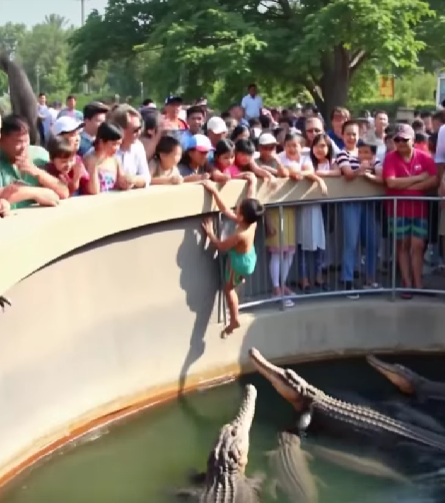
What was supposed to be a fun Saturday afternoon became the most terrifying day the Thompson family had ever experienced.
Hundreds of visitors had gathered at Riverside Wildlife Park to enjoy the warm weather. Children laughed as they watched elephants spray water, monkeys swung from ropes, and colorful birds filled the air with their calls.
Eight-year-old Liam had been especially excited to see the crocodiles.
“They’re my favorite animal,” he told his parents as they walked toward the reptile exhibit.
His father smiled.
“Remember, stay behind the barrier.”
“I will,” Liam promised.
The crocodile habitat was one of the zoo’s largest attractions. Several enormous crocodiles rested motionless near the water’s edge while visitors gathered along the viewing platform.
Many people commented that the reptiles looked like statues.
A zoo educator explained how crocodiles often remain perfectly still for long periods before suddenly moving with incredible speed.
Liam listened carefully, fascinated.
As the presentation ended, families began walking toward the next exhibit.
Liam remained near the viewing area, hoping one of the crocodiles would move.
At that exact moment, he leaned a little farther than he should have while trying to get a better look.
His foot slipped.
Before anyone could react, he tumbled past the viewing area and landed inside the service section of the enclosure near the shallow edge of the habitat.
Gasps echoed through the crowd.
“Liam!” his mother screamed.
The boy was frightened but conscious.
He scrambled backward, trying to move away from the water.
Several visitors immediately called emergency services while zoo staff rushed toward the enclosure.
Years of emergency training immediately took over.
One keeper activated the emergency response alarm.
Another grabbed long safety poles.
Others began making loud noises designed to redirect the crocodiles’ attention away from the child.
The nearest crocodile slowly lifted its head.
Time seemed to stop.
The crowd became completely silent.
Parents covered their children’s eyes.
Several visitors later said those few seconds felt like several minutes.
Senior keeper Michael Harris arrived moments later.
Having worked with crocodiles for nearly twenty years, he knew exactly how quickly the situation could change.
He carefully watched the reptiles while coordinating with the rest of the team.
“Keep the distractions going,” he instructed calmly.
Using the safest route available, Michael entered the protected service area of the enclosure while another keeper remained ready with safety equipment.
Liam had frozen in place.
“It’s okay,” Michael called.
“Stay exactly where you are.”
The boy nodded through tears.
One careful step at a time, Michael reached him.
Without making sudden movements, he picked Liam up and immediately headed back toward the secure exit.
Within moments, both were safely outside the enclosure.
The crowd erupted into applause.
Many visitors wiped away tears of relief.
Liam’s parents rushed forward and hugged him tightly.
Paramedics who had already arrived quickly examined the young boy.
Apart from a few scrapes, bruises, and the emotional shock of the experience, he had escaped serious injury.
Doctors later described his outcome as remarkably fortunate.
Zoo officials temporarily closed the reptile exhibit while conducting a full review of the incident.
Engineers inspected every barrier, gate, and viewing platform.
Although investigators found no evidence of equipment failure, the zoo announced additional safety improvements, including taller protective barriers, extra warning signs, and increased staff presence during busy weekends.
Speaking to reporters later that day, the zoo director praised the emergency team’s professionalism.
“Our keepers train regularly for unexpected situations,” she said.
“Today’s outcome demonstrates the importance of preparation, teamwork, and remaining calm under pressure.”
Michael, however, refused to call himself a hero.
“We’re trained for emergencies,” he explained.
“I’m just grateful the child is safe.”
The story quickly spread across television and social media.
Millions praised the staff’s fast response and the importance of emergency preparedness.
For Liam and his family, though, the experience became a powerful reminder.
Wild animals deserve admiration—but they also deserve respect.
Even the strongest safety barriers cannot replace careful supervision and following zoo rules.
Months later, Liam returned to the zoo with his parents.
This time, he stayed well behind every safety barrier.
When they reached the crocodile exhibit again, he looked at the animals from a safe distance before quietly saying something his parents would never forget.
“I still think they’re amazing.”
“But now I know why everyone tells us not to get too close.”
His father smiled and placed a hand on his shoulder.
“Sometimes,” he said, “the biggest lesson isn’t about being brave.”
“It’s about learning why safety rules exist in the first place.”
The family finished their visit with a new appreciation for the dedicated professionals who care for wildlife every day—and for the importance of respecting both the animals and the boundaries designed to protect everyone.