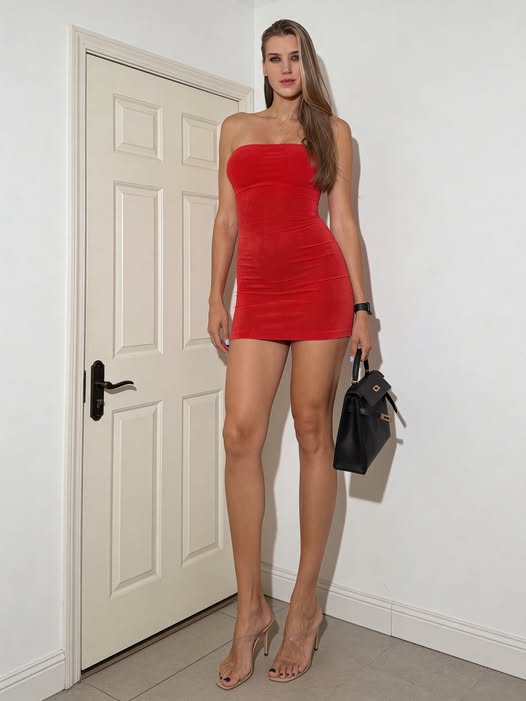
Maya had stopped wearing heels on first dates a long time ago.
Not because she didn’t like them, but because she had learned the pattern too well. The moment she walked into a café, bar, or restaurant wearing anything that added even a few centimeters, she could see it happen in real time: the flicker of surprise, the quick glance upward, the forced smile that followed.
She was 6’3″. Barefoot.
And most men weren’t prepared for that.
It wasn’t always obvious at first. Dating apps never captured scale properly. Photos flattened reality, angles lied, and bios rarely included height unless it was something people bragged about or tried to downplay.
So Maya would show up, always on time, always polite, and always watch the moment the truth arrived before the conversation even began.
Sometimes it was subtle.
A man would stand up to greet her, then pause for half a second too long. His eyes would travel upward, recalibrating expectations. His handshake would feel slightly tighter, as if he needed to reassert something invisible.
Other times, it was less graceful.
“Oh,” they would say. Just that. A single syllable that carried too much meaning.
And then the energy would shift.
Maya never blamed them outright. She understood attraction was complicated, shaped by expectations people didn’t even realize they had. But understanding didn’t make it easier to sit through the slow fading of interest over a single drink.
By the time dessert arrived, most conversations had already drifted somewhere safe — work, travel, hobbies — anything but the unspoken tension of her height.
There were exceptions, of course.
Once in a while, she’d meet someone who didn’t seem to care. Or maybe cared, but in a different way. Someone who would laugh and say, “That’s actually kind of amazing,” instead of shrinking under the reality of it.
Those dates usually gave her hope.
But hope had a habit of not lasting long.
One evening, she met Leo.
He was waiting outside the restaurant when she arrived. Average height, relaxed posture, easy smile. Maya noticed, immediately, that he didn’t look surprised when she approached. No hesitation. No double-take.
“You’re taller than I expected,” he said simply.
“You’re handling it well,” she replied, half-joking.
And for the first time in a while, she meant it when she sat down and didn’t feel like she needed to apologize for taking up space.
The conversation flowed easily. No awkward pauses about appearance. No forced jokes to soften anything. Just two people talking.
But halfway through dinner, Maya noticed something different.
It wasn’t rejection this time. It was curiosity — the kind that lingered. Leo wasn’t uncomfortable, but he was observant in a way that made her uneasy for reasons she couldn’t immediately explain.
“So,” he said at one point, leaning back in his chair, “does this happen a lot?”
“What?”
“People being… surprised.”
Maya gave a small shrug. “More than I’d like.”
He nodded like he understood something deeper than the words themselves.
But as the night went on, she realized something else. It wasn’t her height that unsettled people like Leo — it was the assumptions they attached to it. Strength. Presence. Intimidation. Things she never claimed for herself, but others seemed eager to project.
By the time they left the restaurant, the air between them had shifted again.
Not rejection.
Not attraction either.
Something more complicated.
Outside, under the streetlights, Leo hesitated. “You know,” he said, “most people would probably find you intimidating.”
Maya almost laughed. “I’m just trying to get through dinner dates without them ending early.”
He smiled faintly. “Yeah. I think that’s the problem. People don’t know where they fit next to you.”
She didn’t respond right away.
Because for once, it wasn’t about height.
It was about space.
And as she walked home alone that night, Maya realized something she hadn’t put into words before:
Maybe it wasn’t that men ran from her.
Maybe they just didn’t know how to stand beside her without feeling like they were disappearing.