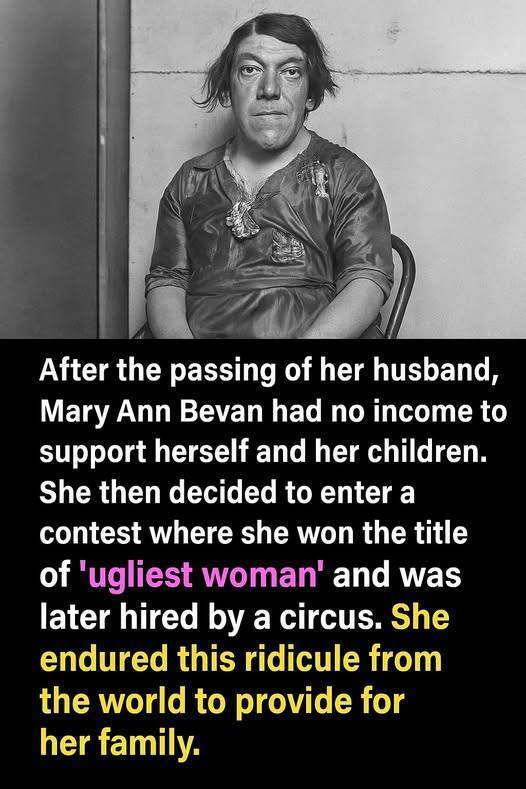
In her early years, Mary Ann lived a life that was neither extravagant nor deprived. She grew up in an era marked by rigid social expectations, particularly for women, whose opportunities were often limited by class, appearance, and marital status. Despite these constraints, her youth was defined by routine comforts, close family relationships, and the promise of an ordinary life. She trained as a nurse, a profession that required discipline, compassion, and resilience—traits that would later become essential to her survival.Mary Ann Bevan’s life story is often summarized in a single, oversimplified phrase, but such a narrow lens fails to capture the depth, courage, and determination that defined her journey. Her life was not merely shaped by hardship—it was guided by responsibility, love, and an unbreakable will to provide for her family under circumstances few could imagine. Born into a modest household in late-nineteenth-century Britain, Mary Ann entered the world with hopes similar to those of many women of her time: stability, family, and a future built on shared effort and care.
Marriage brought her happiness and a sense of security. She built a home, raised children, and envisioned a future grounded in love and shared responsibility. Like many families of the time, her household relied on mutual effort rather than wealth. Life, though not easy, was meaningful. However, stability proved fragile. The sudden loss of her husband marked the beginning of a profound transformation in her life—emotionally, socially, and economically.
Widowhood in early twentieth-century Britain carried heavy consequences. Social support systems were minimal, employment options for women were limited, and financial independence was difficult to achieve, particularly for mothers with dependents. Mary Ann was left not only with grief, but with the pressing reality of providing for her children in a society that offered little assistance.
As she navigated loss, another challenge emerged—one that altered her physical appearance in ways she neither chose nor controlled. A medical condition gradually changed her facial features and body, drawing attention in a culture that harshly judged physical difference. At a time when women were frequently valued for conformity to narrow beauty standards, such changes carried social stigma and economic consequences.
This shift did not occur overnight, nor did it define who Mary Ann was as a person. Yet society’s reaction to visible difference was unforgiving. Opportunities diminished, judgment increased, and isolation became a constant companion. For many, such circumstances might have led to withdrawal or despair. For Mary Ann, they prompted a difficult but deliberate decision rooted in responsibility rather than resignation.
Faced with limited employment options and the urgent need to support her children, she made a choice that demanded extraordinary emotional strength. She entered the world of public exhibitions—an industry that capitalized on curiosity and spectacle. This decision was not driven by vanity or desire for attention, but by necessity. Each appearance represented school fees, meals, and stability for her children.
The environments she worked in were challenging. Public exhibitions were demanding both physically and emotionally. Crowds arrived with curiosity rather than empathy, often unaware of the personal story behind the presentation. Mary Ann endured long days, repetitive routines, and public scrutiny that would have been deeply uncomfortable for anyone. Yet she remained focused on the purpose behind her work: ensuring that her children had opportunities she herself had lost.
Importantly, Mary Ann was not passive in this arrangement. She approached her work with intention and awareness, understanding its temporary nature and long-term benefit. Rather than internalizing society’s judgments, she redirected their impact toward something meaningful. In doing so, she demonstrated agency in a system that rarely allowed women—especially widows—to exert control over their economic fate.
Her resilience did not mean the absence of hardship. The emotional toll of constant public exposure was real. Still, Mary Ann carried herself with professionalism and quiet dignity. Those who worked alongside her noted her composure and reliability. She was not defined by the labels assigned to her, but by the discipline and resolve she brought to her role as a provider
What often goes unrecognized in historical accounts is the strategic intelligence behind her choices. Mary Ann understood that her circumstances were unlikely to improve without decisive action. Rather than waiting for sympathy or assistance that might never come, she created a path forward using the limited options available. Her decisions reflected foresight, sacrifice, and an unwavering commitment to her children’s future.
Through her efforts, her children received education and opportunities that would have otherwise been inaccessible. Books, schooling, and stability were the tangible results of her labor. While the public saw only a brief performance, the lasting impact of her work unfolded quietly within her family, shaping lives long after the exhibitions ended.
Mary Ann’s story also reveals much about the social attitudes of her time. Public fascination with physical difference often overshadowed individual humanity. Yet within that environment, she maintained her sense of self. She was a mother first, a worker second, and a public figure only by circumstance. Her identity was never confined to what others saw.
In later years, as her health declined, she continued to prioritize her children’s well-being. The physical demands of her work were considerable, yet she persisted as long as she was able. Her endurance was not fueled by recognition or reward, but by a sense of duty that transcended discomfort and judgment.
Today, Mary Ann Bevan is often remembered through photographs and brief historical notes that fail to convey the complexity of her life. To truly understand her legacy, one must look beyond surface impressions and consider the broader context of her decisions. She lived in a time with limited choices, strict gender roles, and minimal social safety nets. Within those constraints, she exercised remarkable courage.
Her life challenges modern audiences to reconsider how strength is defined. Strength does not always appear as defiance or public protest. Sometimes it exists quietly in daily perseverance, in choices made under pressure, and in sacrifices that go unseen. Mary Ann’s strength was not loud, but it was enduring.
Her story also invites reflection on empathy and perspective. The judgments placed upon her say more about societal values than about her character. By viewing her life through a lens of understanding rather than spectacle, we can honor her humanity and the love that guided her actions.
Mary Ann Bevan’s legacy is ultimately one of responsibility fulfilled under extraordinary circumstances. She transformed limitation into purpose and adversity into opportunity—not for herself alone, but for those who depended on her. Her life reminds us that dignity is not granted by appearance or approval, but claimed through intention, resilience, and care for others.
Remembering her today means acknowledging the full scope of her experience: the loss, the challenges, the choices, and the unwavering commitment to family. Her story is not defined by how she was presented to the public, but by what she achieved behind the scenes—a future secured for her children through perseverance and resolve.
In honoring Mary Ann Bevan, we honor all those whose strength unfolds quietly, without recognition, in the service of love and responsibility. Her life stands as a testament to the enduring power of determination, compassion, and purpose in the face of overwhelming odds.