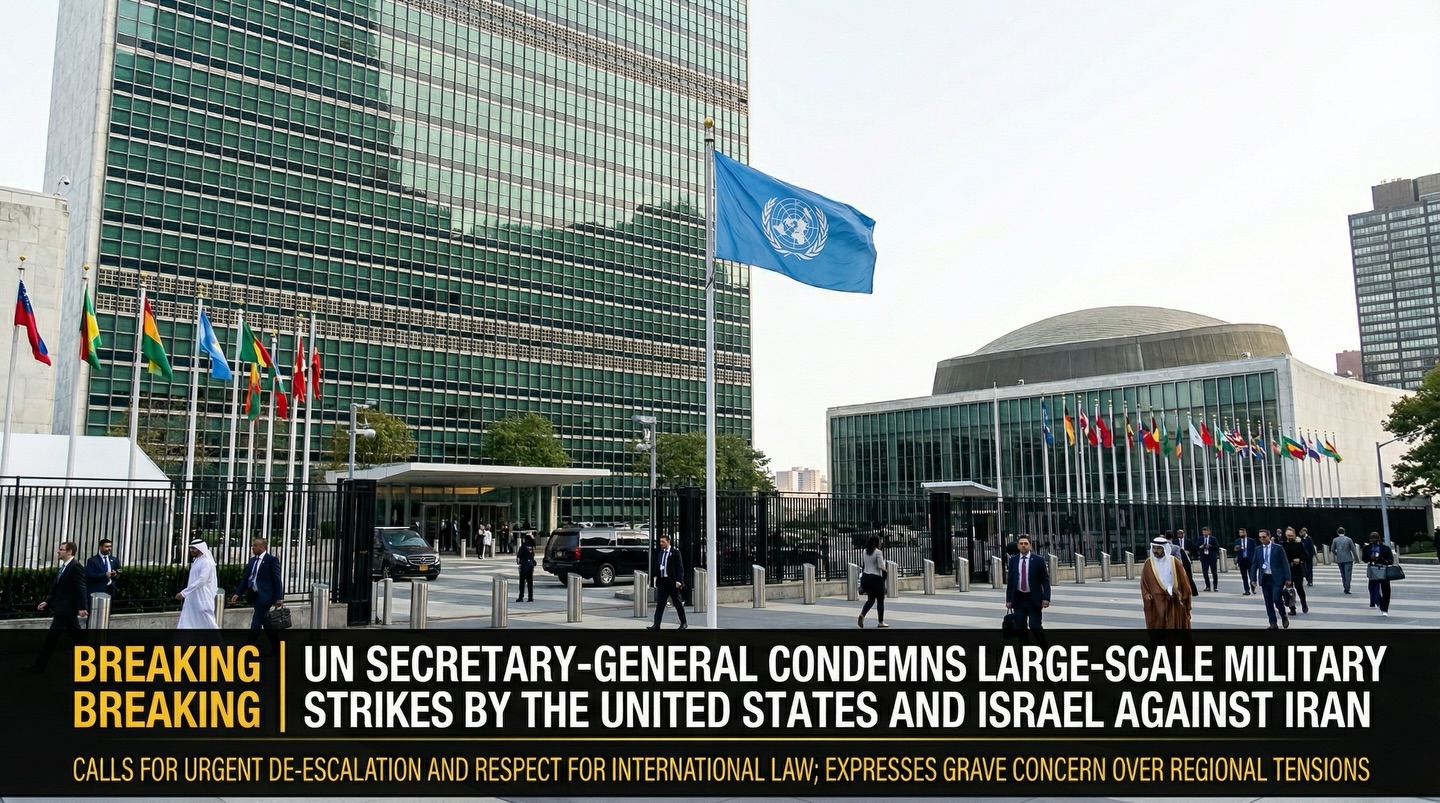
United Nations Secretary-General António Guterres has strongly condemned the recent large-scale military strikes carried out by the United States and Israel against Iran, describing the escalation as a serious threat to international peace and security, according to official statements and global reaction.
In a formal statement released on February 28, 2026, Guterres said he “condemns today’s military escalation in the Middle East,” emphasizing that the use of force by the United States and Israel against Iran — followed by retaliatory actions across the region — “undermine international peace and security.” He warned that failure to halt the violence could lead to a much broader regional conflict with “grave consequences for civilians and regional stability.”
Guterres reiterated that all U.N. member states are obligated to respect international law, including the U.N. Charter, which prohibits the use or threat of force against the territorial integrity or political independence of any country. In calling for an immediate cessation of hostilities, he urged all involved parties to return to diplomatic negotiations as the only viable path toward long-term peace.
The statement came amid widespread international concern after coordinated military action by U.S. and Israeli forces targeted multiple sites in Iran earlier in the day, triggering retaliatory strikes by Tehran and heightened tensions across the Middle East. World leaders have reported explosions and clashes in several countries, and global markets reacted to the increased risk of regional instability.
The U.N. chief’s remarks were echoed by the United Nations Human Rights Chief, who described the ongoing violence as a source of “death, destruction and human misery,” particularly for civilians who often bear the greatest impact in armed conflicts.
Guterres’ call for de-escalation also coincided with an emergency meeting of the U.N. Security Council, convened to address the rapidly evolving situation and to discuss potential diplomatic measures that could prevent further escalation. Several nations, including France, Russia, China, and others, supported the need for an emergency session, underscoring the depth of international concern.
While some governments have defended the strikes as necessary for national security, others have condemned them as violations of international law that could destabilize the region further. Member states have varied in their responses, but many agree that diplomatic engagement must be renewed to avert an even wider conflict.
The United Nations has emphasized the risk of a humanitarian crisis should hostilities continue, warning that civilian populations in Iran, Israel, and neighboring countries could face severe consequences if the violence is not swiftly halted.
For now, the international community remains on high alert, awaiting further developments and hoping that diplomatic channels can be reopened to defuse one of the most serious escalations in Middle East tensions in recent years.