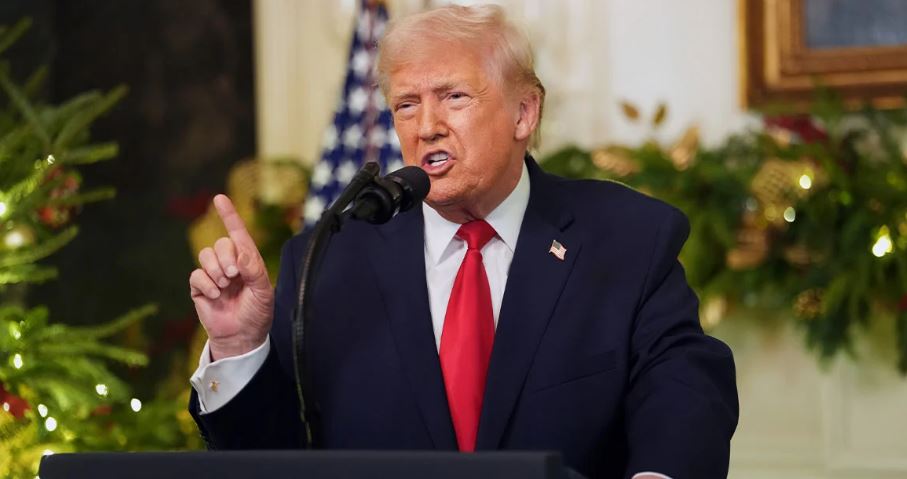
In a dramatic escalation of hostilities in the Middle East, United States President Donald Trump said he believes Iran’s Supreme Leader, Ayatollah Ali Khamenei, has been killed in a coordinated military offensive conducted with Israel — an assertion that has sent shockwaves through global capitals and raised urgent questions about next steps in a burgeoning regional conflict.
On Saturday, February 28, 2026, the U.S. and Israeli militaries launched a large‑scale series of air and missile strikes across Iran, targeting sites tied to the Islamic Revolutionary Guard Corps (IRGC), air defense systems, missile bases and key leadership compounds. In a televised interview with ABC News, President Trump said he “believes” Supreme Leader Khamenei was killed in the attack, though he stopped short of declaring the matter definitively confirmed.
Israeli Prime Minister Benjamin Netanyahu echoed that claim, saying there were “growing signs” indicating Khamenei may no longer be alive after intense strikes hit his compound in Tehran. Israeli officials later told Reuters that they had located what they identified as Khamenei’s body among the rubble, though Iranian authorities have denied this.
The U.S. president framed the offensive as a necessary act to neutralize an imminent existential threat. In his remarks, Trump said the offensive was aimed at dismantling Iran’s nuclear program and crippling its ability to project military power across the Middle East. He also appealed directly to Iranian security forces to lay down their arms, offering immunity to those who comply and urging ordinary Iranians to oust their government.
Iran has strongly denied the claims. Tehran’s Foreign Ministry stated that Khamenei and Iranian President Masoud Pezeshkian were alive, with Iran’s top diplomat telling NBC News that “as far as I know,” senior leadership remained “safe and sound.” Iranian state media called the reports of Khamenei’s death part of “enemy mental warfare.”
The conflicting reports have created a fog of uncertainty over the situation in Tehran, where explosions were heard and emergency sirens sounded across the capital. Global news agencies report that air defenses were overwhelmed in the early hours of the assault, and multiple senior members of Iran’s military — including commanders in the IRGC — were killed.
Retaliation has already begun. Within hours of the initial strikes, Iran launched ballistic missiles and drone attacks at Israeli territory and U.S. military bases across the region, including in Gulf states hosting American troops. Casualties have been reported, though details remain incomplete as of this writing.
Global Reaction
World leaders have reacted with alarm. The United Nations Security Council convened an emergency session amid growing calls from international figures for restraint and a ceasefire. European Union officials called for an immediate de‑escalation, while China and Russia condemned the U.S.–Israeli offensive as a violation of international law.
Neighboring countries — including Iraq, Syria, and members of the Gulf Cooperation Council — have condemned the attacks and expressed fears of a broader conflagration that could engulf the entire Middle East. Pro‑Iranian demonstrations have erupted in several capitals, and Yemeni Houthi fighters vowed solidarity with Tehran.
Global oil markets reacted instantly, with prices spiking amid fears of supply disruption through the strategically vital Strait of Hormuz. Economists warned that prolonged conflict could have ripple effects on global energy markets and supply chains.
What Comes Next
At the heart of the uncertainty remains the question of whether Khamenei is truly dead — with Israeli claims and U.S. statements on one side, and Iranian denials on the other. If verified, the death of Iran’s supreme leader — who had ruled since 1989 and held absolute authority over the country’s political, military, and religious spheres — would mark a historic turning point with far‑reaching consequences.
Analysts warn that without clear communication and diplomatic channels, the risk of a wider regional war — and even confrontation involving major global powers — is sharply rising. Diplomatic efforts, including those previously mediated by Oman and other neutral parties, have been thrown into uncertainty by the speed and scale of the military action.
As the world awaits independent confirmation of Khamenei’s fate and de‑escalation efforts, the Middle East stands on a knife’s edge, with implications that could reverberate for years to come.