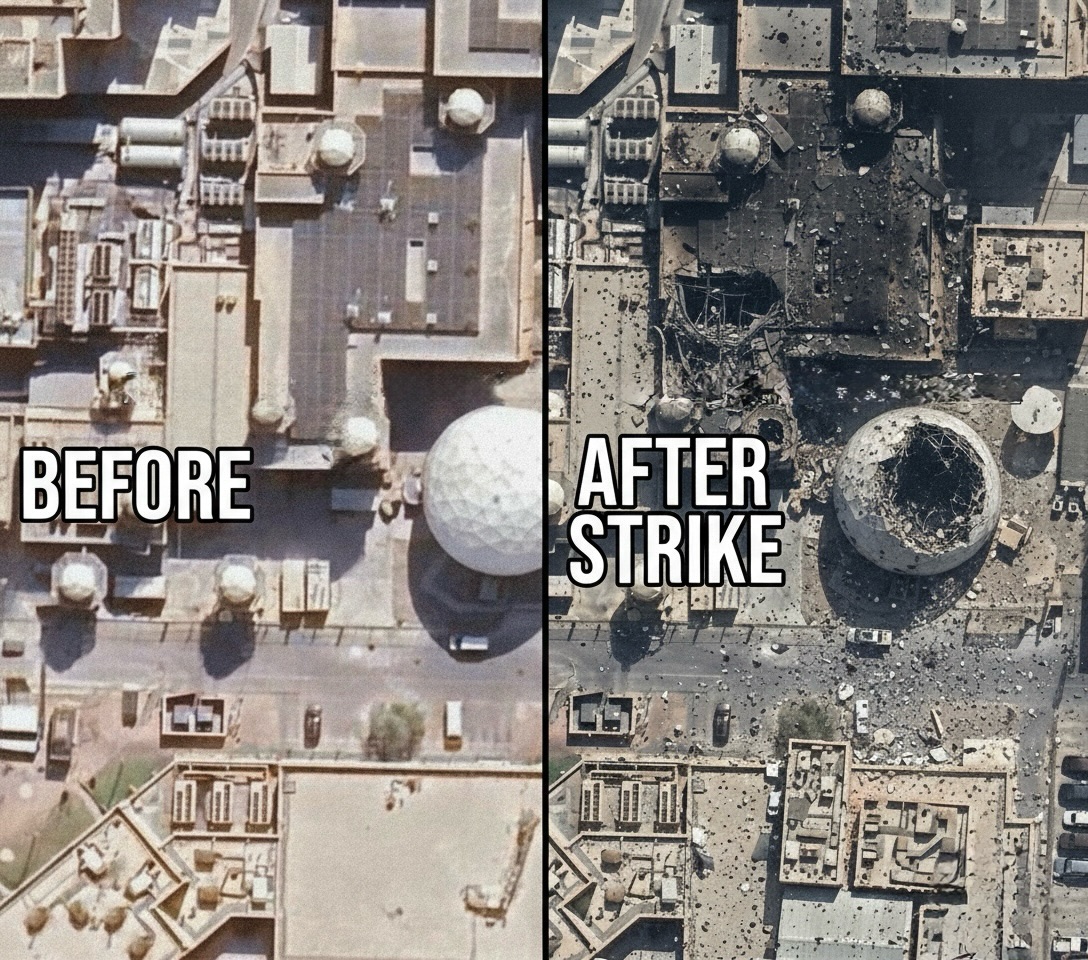
Iran’s Islamic Revolutionary Guard Corps (IRGC) has announced that it destroyed a U.S. early-warning radar system — the AN/FPS-132 — at a military facility in Qatar during a series of coordinated strikes, according to multiple regional reports.
The AN/FPS-132 Block 5 radar is a highly advanced early warning and missile-tracking system, capable of detecting ballistic missile launches at distances up to approximately 5,000 kilometers. It forms part of the missile defense infrastructure supporting U.S. and allied forces in the region and is estimated to be worth around $1.1 billion.
In a statement shared on Saturday, Iranian officials said the radar installed near Al-Udeid Air Base in Qatar was targeted as part of retaliatory operations after recent attacks involving U.S. and allied forces in the Middle East. The IRGC described the strike as successful, claiming that the long-range radar installation was “completely annihilated.”
While the Iranian announcement has circulated widely on social media and in state-affiliated media outlets, U.S. authorities have not yet independently confirmed the destruction of the system. Western military analysts caution that even if the radar were disabled, it would not necessarily translate into a permanent capability loss — the U.S. military operates multiple radar and sensor platforms across the region.
The strike appears to be part of a broader escalation of hostilities, with Iran claiming multiple U.S. military sites in the Middle East are legitimate targets in its ongoing campaign. Reports suggest missiles and drones were used to strike bases in several countries, heightening tensions across the Gulf and drawing international attention.
Experts note the strategic importance of the AN/FPS-132 radar: it feeds early-warning data to integrated missile defense systems, including the U.S. Terminal High Altitude Area Defense (THAAD) network and allied deployment strategies. Its alleged destruction, if verified, could reduce early-warning time and sensor redundancy, even as other systems continue to operate.
The incident underlines the continuing volatility in the region, where military engagements between Iran and U.S. forces have intensified over recent weeks. Global leaders are calling for restraint amid fears of further escalation, while defense analysts emphasize the delicate balance between action and diplomatic fallout.
More details — including responses from U.S. and Qatari officials and any potential impact on regional security — are expected to emerge as international monitoring continues.