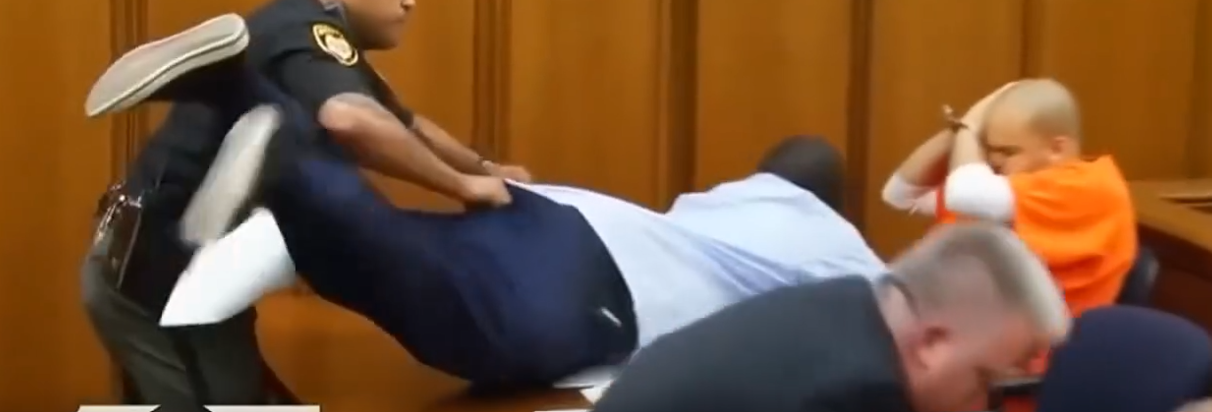
Inside a Cleveland courtroom, a sentencing hearing became an extraordinary and deeply emotional moment when the father of a murder victim confronted the man responsible for his daughter’s death.
Van Terry had entered the courtroom carrying something no parent should ever have to carry: the loss of his 18-year-old daughter, Shirellda Terry.
The hearing was supposed to be about justice and sentencing. Michael Madison had been convicted of murdering Shirellda and was facing the ultimate punishment. The legal process had reached the stage where the victim’s family could speak about the person they had lost and the consequences of the crime.
But for Van Terry, this was never simply another courtroom proceeding.
Behind the legal language, court documents, testimony, and arguments was the absence of his daughter.
Shirellda was only 18 when her life was taken. For her family, the loss was not something that could be measured by a sentence handed down by a judge. A prison term, a verdict, or even a death sentence could not bring her home.
That reality became painfully visible during the hearing.
Terry had been given the opportunity to address the court and speak about his daughter. Victim-impact statements can be among the most difficult moments in criminal proceedings because they allow surviving family members to describe the consequences of a crime in deeply personal terms.
For families, the opportunity can provide a way to put into words what has been lost.
For prosecutors and judges, it provides an important reminder that criminal cases involve real people whose lives continue to be affected long after the crime itself.
Terry attempted to fulfill that role.
He spoke as a father mourning his daughter and as a family member trying to make sense of an unbearable reality.
But at some point, his attention turned toward Madison.
The courtroom suddenly became a place where two completely different realities collided.
On one side was the defendant, already convicted and facing a death sentence.
On the other was the father of the young woman whose life had been taken.
Terry looked toward the man responsible for his daughter’s death.
What happened next was captured in courtroom footage and became widely known because of the extraordinary emotion displayed in those few seconds.
Terry suddenly moved toward Madison, crossing the space between them.
Court deputies immediately reacted.
They intervened and restrained him before the confrontation could continue.
The moment was brief, but its emotional impact was enormous.
For observers watching the footage, it was impossible to separate the incident from the circumstances surrounding it.
This was not a disagreement between strangers.
It was the reaction of a father who had lost his teenage daughter and was suddenly standing in the same room as the person convicted of killing her.
The courtroom is designed to create order.
There are procedures for everything.
Judges speak from the bench.
Attorneys make arguments.
Witnesses testify.
Defendants sit at designated tables.
Victims’ families are given opportunities to speak.
Security officers maintain control.
The structure exists partly because criminal proceedings involve enormous emotions and serious consequences.
But grief does not always follow courtroom procedure.
Anger does not arrive according to a schedule.
And the pain of losing a child cannot always be contained by the formal language of a legal proceeding.
That is what made Terry’s reaction so powerful to many people who later saw the footage.
The court had already determined Madison’s legal responsibility.
The jury’s verdict had established guilt, and the sentence represented the punishment available under the law.
Yet none of those legal decisions could change what had happened to Shirellda.
Her family would still return home without her.
They would still experience birthdays and holidays without her.
They would still encounter reminders of a life that should have continued.
That distinction is important when considering emotional moments inside courtrooms.
The legal system deals primarily with questions of responsibility and punishment.
Families often live with questions that have no legal answer.
Why did this happen?
Why did their loved one have to die?
What would she have become?
What memories will they never get to make?
What would her life look like today?
A verdict cannot answer those questions.
Neither can a sentence.
This is one reason victim-impact statements exist.
They give surviving family members an opportunity to describe the human consequences of a crime in their own words.
The courtroom therefore becomes more than a place where evidence is reviewed.
It becomes a place where families confront the person whose actions permanently changed their lives.
For Terry, that confrontation was particularly painful because his daughter had been only 18.
At that age, a person is just beginning adulthood.
There are possibilities ahead: education, relationships, careers, travel, family, and countless ordinary experiences that most people take for granted.
Shirellda never had the opportunity to experience those things.
Her family was left to imagine the future she should have had.
The emotional reaction displayed by her father should also be understood within that broader context.
Grief can manifest differently from person to person.
Some people become quiet.
Some cry.
Some speak continuously.
Others struggle to speak at all.
And sometimes grief emerges as anger.
That anger does not erase the legal process, nor does it change the facts established by a court. It reflects the extraordinary emotional burden carried by someone who has experienced a devastating loss.
After deputies intervened, order was restored and the proceedings continued.
The legal process did not stop simply because emotions had briefly overwhelmed the courtroom.
That return to procedure is itself significant.
Courts are designed to continue functioning even when the people inside them are experiencing profound emotional pain.
The judge, attorneys, deputies, defendant, and family members all remain part of a system that must operate according to established rules.
But the incident demonstrated the limits of what those rules can contain.
No courtroom can make a grieving parent stop being a parent.
No verdict can make a murdered child return home.
And no sentence can completely repair a family destroyed by violence.
The story of Van Terry and Shirellda therefore became more than a story about a courtroom disturbance.
It became a glimpse into the human consequences that remain after a criminal case reaches its legal conclusion.
For those watching from outside, it can be tempting to focus only on the dramatic moment—the movement across the courtroom, the deputies rushing to intervene, and the sudden disruption of the proceedings.
But behind those seconds was a much larger story.
A young woman had lost her life.
A family had lost a daughter.
A father was forced to stand before the man convicted of taking her away.
And a court was attempting to transform an unimaginable tragedy into a legal judgment.
Those things are not the same.
Justice can establish accountability.
It can impose punishment.
It can recognize wrongdoing.
But grief belongs to another realm.
It continues after the courtroom empties.
It remains after the cameras disappear.
It follows families into their homes and through the ordinary moments of everyday life.
That is perhaps the most painful lesson of the case.
For the justice system, a criminal case eventually reaches an ending.
For a family that has lost a loved one, there may never be a true ending.
There is only learning how to live with the absence.
The emotional courtroom moment involving Van Terry offered a brief, unforgettable glimpse into that reality.
It showed that behind every criminal case are people whose lives have been permanently changed.
And while the law can deliver a verdict, it cannot erase the pain of losing someone you love.
For a father mourning his daughter, that pain can remain long after the judge has left the courtroom and the legal proceedings have come to an end.