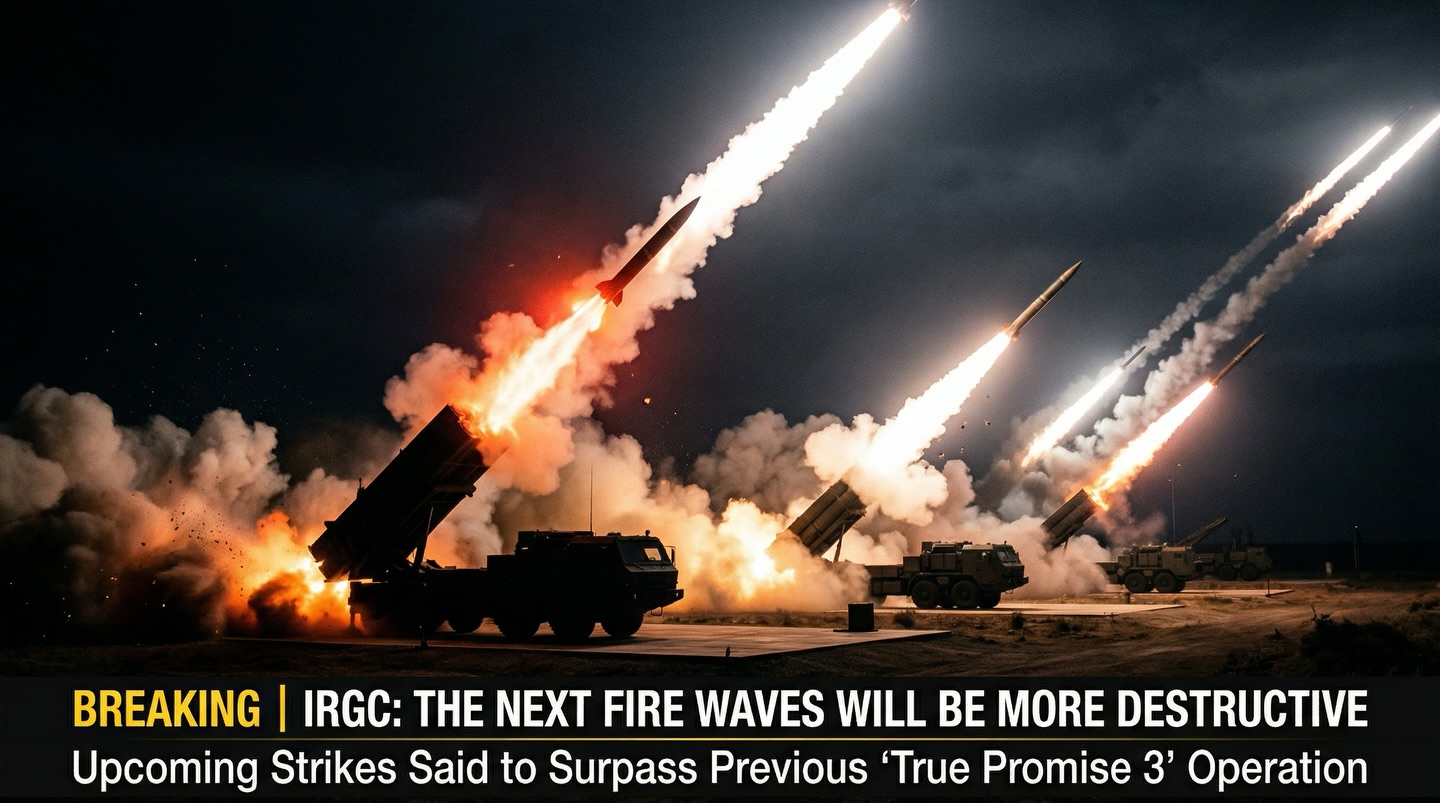
The Islamic Revolutionary Guard Corps (IRGC) has issued a sharply worded statement warning that upcoming military actions will be “far more destructive” and “multiples greater” than its previous operation known as “True Promise 3.”
In a message carried by Iranian state-affiliated media, the IRGC declared: “Let the enemies of the Iranian people know that the القادمة fire waves will be far more destructive—multiples greater than Operation ‘True Promise 3.’ We will draw on past experience and act with initiative in execution.”
The warning comes amid escalating tensions across the Middle East following a series of military exchanges involving Iran, Israel, and the United States. While the IRGC did not specify exact targets or timing, the phrasing suggests preparations for a potentially expanded campaign.
Operation “True Promise 3,” referenced in the statement, was previously described by Iranian officials as a coordinated missile and drone operation designed to demonstrate capability and deterrence. Analysts say invoking the operation by name signals both continuity and escalation — reinforcing Iran’s messaging that it views its recent actions as calculated responses rather than isolated events.
Security experts note that the language used in the statement is intentionally forceful. Phrases such as “far more destructive” and “multiples greater” are likely aimed at deterrence, projecting strength while also shaping public perception domestically and internationally.
The inclusion of the Arabic term “القادمة” (meaning “upcoming” or “next”) in the official wording has drawn attention, as it suggests a sequence rather than a single retaliatory event. Analysts interpret this as a warning of phased or sustained operations rather than a one-time strike.
Regional governments have responded with heightened alert levels. Military installations across several countries have reportedly increased defensive readiness, and airspace monitoring has intensified in parts of the Gulf and eastern Mediterranean.
International leaders are urging restraint. Diplomatic channels are reportedly active, with global powers attempting to prevent further escalation that could destabilize energy markets and regional security.
Meanwhile, markets reacted cautiously following the IRGC’s remarks. Oil prices experienced volatility in early trading, reflecting investor concern about potential disruptions in key transit routes or expanded military engagement.
Defense analysts emphasize that while rhetoric can serve as psychological warfare, the credibility of the threat depends on operational capability and intent. Iran has previously demonstrated the ability to deploy ballistic missiles, cruise missiles, and long-range drones in coordinated operations. However, the scale and scope of any forthcoming action remain uncertain.
The IRGC’s statement underscores the fragile state of regional stability. With recent exchanges already heightening tensions, a significantly larger operation could risk triggering direct confrontation on a broader scale.
At this stage, no additional launches have been officially confirmed. Governments across the region continue monitoring developments closely.
Whether the warning represents imminent action or strategic signaling remains unclear — but the message from Tehran is unmistakable: the next move, if carried out, is intended to be more intense than anything seen so far.