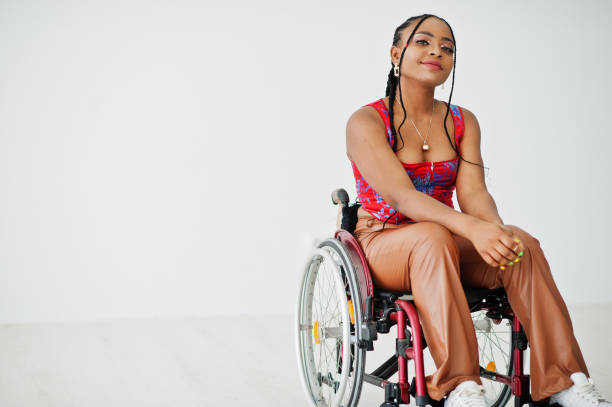
When people first noticed Aaliyah, they noticed everything at once. Her skin caught the light like polished obsidian, her curls framed her face in a way that felt intentional even when it wasn’t, and her laugh—low, unapologetic—turned heads before she ever spoke. Then they noticed the wheelchair. And that’s when the questions started, even if they weren’t always asked out loud.
Aaliyah had learned early that dating, like most things, came with extra steps when the world wasn’t built with you in mind. She was twenty-six, living in a city that claimed to be progressive, scrolling through dating apps that promised connection but often delivered confusion. Bios said things like “love to travel” and “looking for my partner in crime.” Hers said, simply, “Writer. عاشقة للحياة. Great smile. Even better conversation.” She didn’t mention the wheelchair—not because she was ashamed, but because she was tired of being reduced to it.
When she didn’t mention it, some men reacted with surprise that felt like disappointment. “Oh… I didn’t realize,” they’d say on first dates, eyes flicking down before snapping back up, too quick to be subtle. Others leaned in too hard the other way, performing inspiration like it was a compliment. “You’re so strong,” they’d say, as if existing in her body was a motivational speech.
The hardest part wasn’t rejection. Aaliyah could handle that. The hardest part was invisibility—the way desire seemed to short-circuit in people’s minds once disability entered the room. As if beauty and mobility were the same thing. As if her body was a question mark instead of a statement.
She remembered one date in particular, a rooftop bar with string lights and overpriced cocktails. The man was charming online, funny in person, until the conversation drifted to the future. “I just want something… easy,” he said, gesturing vaguely, his eyes betraying what his mouth wouldn’t. Easy. Aaliyah smiled, nodded, and wheeled herself out before the check arrived.
At home that night, she took off her hoops, rubbed coconut oil into her arms, and stared at herself in the mirror. She knew she was hot. Not in a defiant way, not as a protest—just as a fact. Her body had carried her through surgeries, through stares, through loss and reinvention. It deserved love that didn’t come with footnotes.
Dating as a Black woman already meant navigating stereotypes—being seen as too strong, too loud, too much. Adding disability layered on a new set of assumptions: fragile but resilient, dependent but inspiring, sexual but not desirable. Aaliyah lived in the cracks between those contradictions, constantly correcting people who thought they knew her story better than she did.
And still, she kept showing up.
She went on dates where she laughed until her cheeks hurt. She left conversations that felt like interviews. She learned to ask better questions, to name her needs without apology. Accessibility mattered. Patience mattered. Curiosity mattered. If someone couldn’t meet her there, they weren’t her person.
One evening, at a friend’s gallery opening, she met someone who didn’t flinch, didn’t overcompensate, didn’t ask the wrong questions first. He asked about her writing. About the way she saw the world. When he asked about her wheelchair, it was with care, not curiosity for spectacle. When he said she was beautiful, it landed without an asterisk.
Aaliyah didn’t believe in fairytales, but she believed in momentum. In the quiet bravery of staying open. In choosing softness without surrendering boundaries. Dating was still hard. Some days it still hurt. But she was no longer chasing validation—she was moving toward connection.
Love, she realized, wasn’t about being chosen despite her chair. It was about being chosen with her whole self in view. And when it came, it wouldn’t need to be explained.