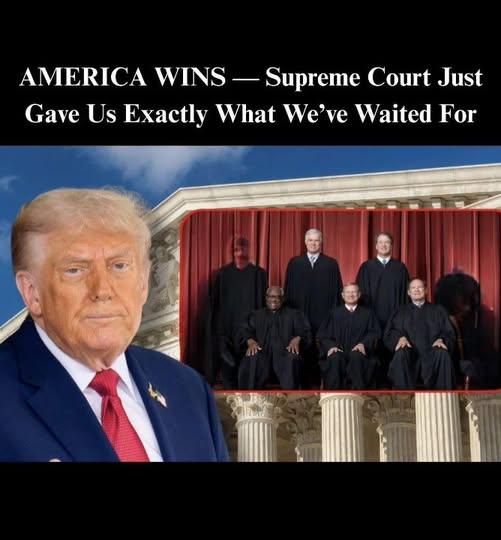
Treasury Secretary Scott Bessent said it is “very unlikely” that the U.S. Supreme Court will overturn President Donald Trump’s use of emergency powers to impose tariffs, as the justices consider a challenge that could be decided as early as this week. The case centers on the president’s authority to invoke emergency statutes to implement broad trade measures without congressional approval.
Speaking during a televised interview, Bessent argued that the Court is generally reluctant to reverse a sitting president’s core economic policies. He suggested that striking down the tariffs could introduce instability into markets and governance. According to Bessent, the administration believes the justices will avoid a ruling that could create widespread economic or political disruption.
The Supreme Court is currently reviewing the president’s use of the International Emergency Economic Powers Act (IEEPA), a law that grants the executive branch broad authority to regulate commerce in response to what it defines as an “unusual and extraordinary threat” to national security, foreign policy, or the economy. The law has historically been used to impose sanctions, freeze assets, and restrict financial transactions, though its application to tariffs has been more controversial.
Bessent’s remarks followed President Trump’s recent announcement of a new round of tariffs targeting several European countries. The tariffs, set to begin at 10 percent on February 1 and rise to 25 percent by June 1, will apply to goods imported from Denmark, Finland, France, Germany, the Netherlands, Norway, Sweden, and the United Kingdom. Trump framed the move as leverage in a broader geopolitical dispute involving Greenland, an autonomous territory within the Kingdom of Denmark.
The president did not explicitly cite the statute authorizing the tariffs but indicated that the measures are consistent with previous emergency trade actions taken under IEEPA. Trump has argued that the United States has long subsidized European nations through favorable trade arrangements and that it is time to reassess those relationships. He has also claimed that the U.S. is uniquely positioned to secure Greenland and address what he describes as growing strategic threats in the Arctic region.
According to Trump, recent pledges by several European nations to deploy military forces to Greenland in support of Danish sovereignty have escalated tensions. He described the situation as dangerous and unsustainable, asserting that economic pressure is necessary to prevent broader conflict. Administration officials have characterized the tariffs as a preventive measure rather than an act of escalation.
Bessent echoed that position, stating that the administration views the Greenland-related tariffs as an emergency action designed to avoid a larger crisis. He argued that the president is using the economic power of the United States as a strategic tool to deter military confrontation and protect long-term national security interests.
Trump has repeatedly expressed interest in acquiring Greenland, citing its strategic location, natural resources, and importance in countering Russian and Chinese influence in the Arctic. In recent weeks, he has intensified public pressure on Denmark and Greenland’s leadership. Officials in Greenland, Denmark, and across Europe have firmly rejected the idea of a U.S. takeover, emphasizing sovereignty and self-determination.
European leaders responded to the tariff announcement with a joint statement expressing solidarity with Denmark and Greenland. They warned that the use of economic threats could undermine transatlantic relations and stressed that any discussions regarding Greenland must respect territorial integrity. The statement called for dialogue rooted in international law and mutual respect.
Diplomatic efforts are ongoing. Senior U.S. officials recently met with representatives from Denmark and Greenland at the White House, after which both sides announced plans to establish a high-level working group to discuss Greenland’s future and regional security concerns.
The Supreme Court is expected to issue a ruling on the use of IEEPA before the end of its current term, though a decision could come sooner. The outcome may have lasting implications for presidential authority over trade policy and the scope of emergency economic powers.