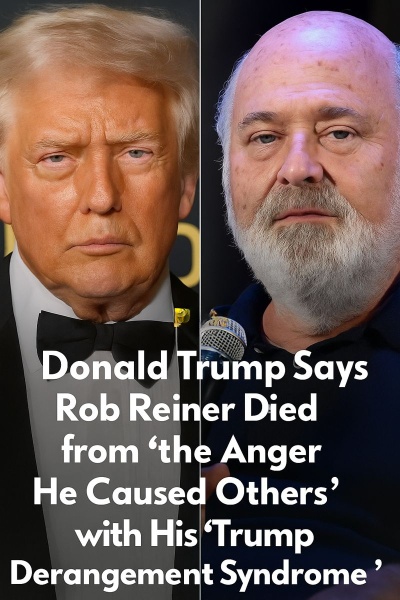
In the later years of his life, filmmaker and public commentator Rob Reiner became increasingly vocal about his concerns regarding the political and cultural direction of the United States. Known for his long career in film and television, Reiner used his public platform not to promote entertainment, but to express a deep sense of unease about what he believed were emerging threats to democratic norms and institutions. His remarks, delivered through interviews, public statements, and social commentary, were not casual observations. They reflected a profound fear that the country he had spent decades celebrating and participating in was moving toward a form of governance that conflicted with its foundational democratic ideals.
At the heart of Reiner’s message was the idea that democracy is not a fixed or guaranteed system. Rather, it is a fragile structure that depends on constant participation, accountability, and a shared commitment to truth. He argued that when citizens become disengaged, when institutions lose independence, or when political leaders undermine public trust in democratic processes, the system itself becomes vulnerable. His warnings were not limited to any single policy or political figure; instead, they reflected a broader anxiety about the long-term health of democratic culture in the United States.
One of Reiner’s recurring themes was the role of information and media in shaping public understanding. He expressed concern that the concentration of media influence, combined with the spread of misinformation and partisan narratives, could distort reality for large segments of the population. In his view, a healthy democracy relies on a well-informed public that can evaluate competing claims and hold leaders accountable. When information ecosystems become polarized or manipulated, he feared that citizens could lose the ability to distinguish between fact, opinion, and propaganda.
Reiner also spoke about the symbolic and psychological dimensions of power. He worried that political rhetoric emphasizing loyalty over law, strength over compromise, and authority over accountability could gradually normalize authoritarian attitudes. While he did not claim that the United States had already crossed a definitive line, he suggested that the warning signs were becoming increasingly difficult to ignore. For him, the danger lay not in a sudden collapse of democracy, but in a slow and incremental weakening of democratic norms that might only be fully recognized in hindsight.
Another aspect of his commentary focused on the relationship between civilian society and state power. Reiner used stark imagery to convey his fears, sometimes referencing historical examples where democratic backsliding was accompanied by visible displays of force or control. These references were not predictions, but cautionary illustrations meant to remind audiences of how quickly political environments can change when checks and balances fail. He emphasized that such developments often begin subtly, under the justification of security, stability, or national unity.
Throughout his public statements, Reiner conveyed a sense of urgency. He often spoke as though time itself were a critical factor, suggesting that the opportunity to reverse damaging trends might be limited. This sense of a “running clock” became a central metaphor in his reflections. It represented not only the political moment, but also his personal awareness of age and legacy. As someone who had lived through multiple political eras, he felt a responsibility to speak while he still could, even if his message was uncomfortable or controversial.
Importantly, Reiner’s warnings were rooted in a deep affection for the country. His critiques were not expressions of cynicism or detachment, but rather of concern and disappointment. He often spoke about the ideals that originally inspired him—freedom of expression, equal justice under the law, and the belief that democratic governance, while imperfect, offered the best path toward collective progress. His fear was that these ideals were being taken for granted or actively undermined.
In the years following his final public statements, Reiner’s words have taken on a different resonance for many observers. With the benefit of hindsight, some interpret his commentary as prescient, while others see it as an example of how political anxiety can intensify during periods of polarization. Regardless of interpretation, there is little doubt that his reflections captured a moment of deep national uncertainty, when questions about identity, governance, and the future of democracy were at the forefront of public discourse.
The irony that many now perceive in Reiner’s words lies in the contrast between his sense of imminent danger and the unpredictability of historical outcomes. History rarely unfolds in clean narratives of warning and consequence. Some fears prove exaggerated, while others reveal themselves in unexpected forms. What remains significant is not whether every detail of Reiner’s concern materialized, but that his commentary reflected a widespread feeling of unease shared by many citizens during that period.
His focus on democracy’s vulnerability serves as a reminder that political systems depend not only on constitutions and laws, but also on cultural norms and shared values. When trust erodes—whether in elections, institutions, or one another—the stability of the system can be compromised. Reiner believed that restoring and maintaining that trust required honesty, accountability, and a willingness to confront uncomfortable truths.
It is also worth noting that political warnings, especially from public figures, often generate strong reactions. Some critics argued that Reiner’s language was overly dramatic or alarmist, suggesting that it contributed to polarization rather than constructive dialogue. Others defended his right to speak forcefully, emphasizing that history shows the cost of ignoring early signs of democratic decline. This tension highlights an enduring challenge within free societies: balancing passionate advocacy with measured discourse.
Reiner’s legacy, in this regard, is not confined to the accuracy of his predictions. Instead, it lies in his insistence that democracy is a living system that requires vigilance. His reflections encourage readers and listeners to think critically about power, accountability, and the responsibilities of citizenship. Even those who disagreed with his conclusions may still find value in the broader question he posed: how does a society recognize when its democratic principles are under strain?
As time passes, the emotional weight of Reiner’s final warnings may soften, but their thematic relevance is likely to persist. Nations across the world continue to grapple with challenges related to governance, information, and public trust. In this broader context, his commentary can be understood not as a definitive judgment on a single political era, but as part of an ongoing conversation about how democracies endure, adapt, or fail.
Ultimately, the enduring power of Reiner’s words comes from their human dimension. They reflect the perspective of someone who witnessed decades of social change and felt compelled to speak honestly about his fears for the future. Whether viewed as cautionary, controversial, or reflective, his statements underscore a fundamental truth: democracy is sustained not by complacency, but by continuous engagement and reflection.
The irony many now associate with his final years is not simply that events unfolded in complex ways, but that his sense of urgency captured a moment when the future felt profoundly uncertain. His words continue to echo not because they offer simple answers, but because they raise enduring questions about how societies define freedom, power, and responsibility in times of political strain.